Understanding 14-inch Diamond Saw Blades
Dec 10, 2025

Diamond Cutting Blade mainly consists of two parts: the base and the cutting head. The base is the main supporting part that holds the cutting head, while the cutting head is the part that performs the cutting during use. The cutting head is continuously consumed during use, while the base remains intact. The diamond cutting blade's durable design ensures that the diamonds are securely encased in metal within the cutting head, providing long-lasting durability and high cutting performance.
The cutting speed of diamond saw blades is influenced by factors such as equipment conditions, the quality of the saw blade, and the nature of the material being cut. To achieve the best balance between diamond saw blade lifespan and cutting efficiency, it is crucial to select the appropriate cutting speed based on the properties of the material being processed.
When cutting granite, the optimal cutting speed for the diamond saw blade typically ranges from 25 m/s to 35 m/s. For granite with a high quartz content, which is more difficult to cut, it is advisable to select the lower end of this range. In the production of granite tiles, smaller diamond cutting blades with a reduced diameter are often used, allowing for higher cutting speeds that can reach up to 35 m/s.

Diamond Saw Blade Feed Rate
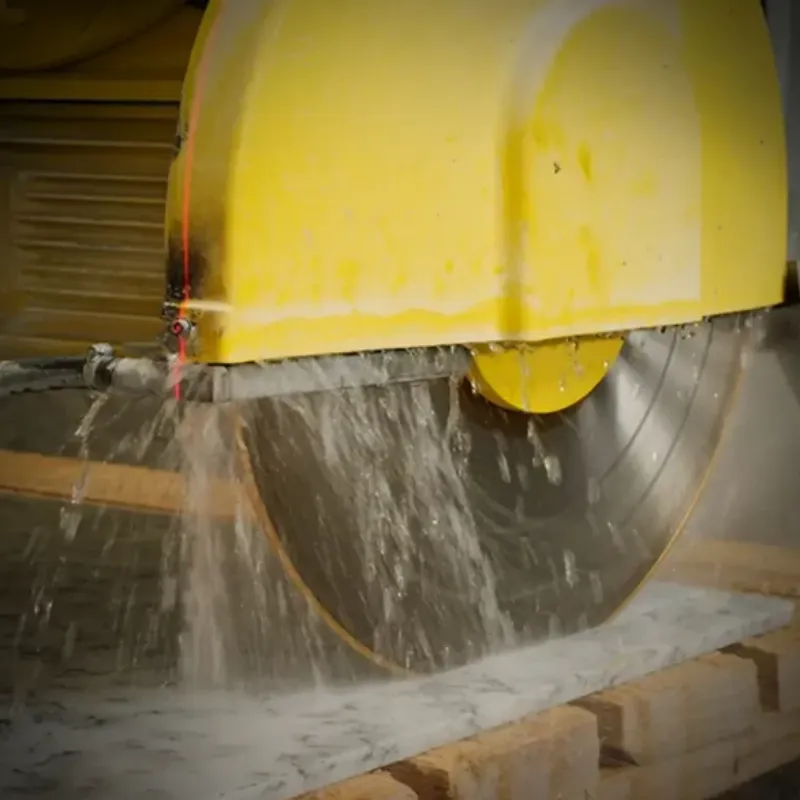
The feed rate, also known as the advancement speed, refers to the speed at which the material being cut moves towards the diamond saw blade. This rate significantly affects the cutting efficiency, blade stress, and heat dissipation in the cutting zone. The optimal feed rate should be selected based on the characteristics of the material being processed.
For softer stones like marble, the feed rate can be increased slightly to improve cutting efficiency. If the feed rate is too low, it may help to increase the cutting rate. When cutting fine-grained, more homogeneous granite, the feed rate can also be adjusted to a higher value. However, if the feed rate is too low, it may cause the diamond edge to become dull quickly.
When cutting coarse-grained granite with uneven hardness, the feed rate should be reduced. If the feed rate is too high, it can cause vibrations that may lead to diamond fracture, reducing cutting efficiency.
The optimal feed rate for cutting granite generally ranges from 9 m/min to 12 m/min, depending on the specific characteristics of the material.