Working Principle of Handheld Laser Marking Machine
Oct 16, 2025
Working Principle of Handheld Laser Marking Machine: Achieving Precise Marking in 3 Steps
1.Laser Generation: From "Electrical Energy" to "High-Energy Beam"
The built-in laser generator (such as fiber laser, CO₂ laser; different types are suitable for different materials) is the core component of the equipment. After being powered on, the medium inside the generator (such as rare earth elements in optical fibers, CO₂ gas) is excited by electrical energy and releases photons of a specific wavelength. These photons are converged and amplified by a reflector to form a laser beam with concentrated energy. This step is equivalent to providing an "energy source" for the "marking tool", and the laser power (e.g., 20W, 60W) is also determined at this stage.

2.Beam Control: Enabling the Laser to "Aim Precisely"
The generated laser beam is regulated by the optical system (including focusing lens and galvanometer) inside the equipment:
- Focusing lens: Converges the scattered laser beam into an extremely thin "light spot" (with a diameter as small as the micrometer level). The thinner the light spot, the higher the marking precision.
- Galvanometer (equipped in some models): Driven by control system instructions, it quickly changes the reflection direction of the laser beam like a "small mirror", making the light spot move according to the preset text and pattern trajectory.This step is comparable to drawing with a "laser pointer" following a template, yet with much faster speed and far more precise trajectory.
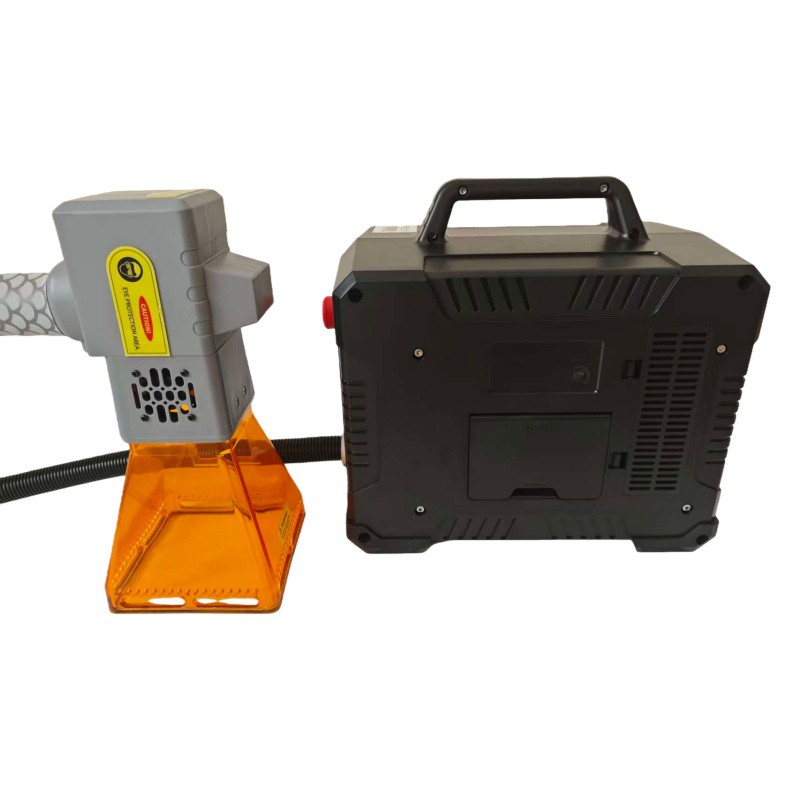
Meanwhile, the design of the handheld marking head enables the operator to flexibly adjust the distance between the laser focal point and the material surface, ensuring the laser beam acts precisely on the area that needs marking.
3.Material Interaction: From "Beam" to "Visible Mark"
When the focused laser beam contacts the material surface, different physical/chemical changes occur according to the material properties, and finally marks are formed. There are 3 common interaction methods:
- Surface removal: The laser energy instantly melts or vaporizes the surface layer of the material (such as the oxide layer on the metal surface, the plastic surface layer), exposing the substrate of a different color underneath, forming an "engraved" mark (e.g., black serial numbers on stainless steel).
- Color change: Under the action of the laser, the molecular structure of the surface layer of some materials (such as certain plastics and anodized aluminum) changes, showing a color different from the original material (e.g., white plastic turns into black text), and marks can be formed without removing the material.
- Micro-deformation: Low-energy laser can cause slight deformation of the material surface layer (such as tiny dents on the metal surface), and marks are presented through the difference in light reflection, which is suitable for scenarios requiring high surface flatness.
The entire process is coordinated synchronously by the equipment's control system. From receiving the "marking pattern" instruction to the laser beam completing the trajectory movement, it only takes milliseconds to seconds, which not only ensures efficiency but also achieves high-precision and stable marking.